Intelligence belongs where the work happens.
Advanced AI infrastructure for locally controlled environments. Keyloh builds frontier-capable systems that run entirely within your organisation’s boundary — owned, not rented; unmetered, not priced by the token.
The most consequential technology of our time is held at a distance.
Rented by the token, reached through someone else’s network, governed by someone else’s terms.
Every previous wave of computing followed the same arc. Capability began centralised — the mainframe, the timeshare, the terminal — and then, as economics and engineering matured, it moved outward: onto desks, into hands, into the fabric of ordinary work. Each time, the move outward is where the value compounded.
Artificial intelligence is midway through the same arc. Its capability is extraordinary; its distribution is not. The organisations with the most to gain from it — those whose work is sensitive, regulated, continuous, or remote — are precisely the ones the centralised model serves least well.
Keyloh exists for the second half of the arc.
What the moment demands
For advanced AI to move outward — from concentrated infrastructure into the environments where value is actually created — three conditions have to hold at once.
-
Control
Intelligence applied to important work must answer to the organisation doing the work — its data remaining within its own boundary, its operation continuing whether or not the outside world cooperates.
-
Economics
Capability priced by the meter punishes exactly the adoption it should reward. The move outward requires ownership — a fixed cost for an unmetered capability.
-
Practicality
What took a data centre and a specialist team must arrive as something an ordinary organisation can simply place, power, and use — capability without ceremony.
What Keyloh builds
No single technology satisfies those conditions. Keyloh works across three layers, each reinforcing the others, together forming one coherent direction.
-
Systems
Frontier-capable computing in forms that live where people work — quiet, compact, powered from the wall, and serious enough for the largest openly available models. In development on commercially available accelerator and memory technologies.
-
Software
Operating environments conceived for local AI from the first line: capability arriving ready rather than assembled, coordinated rather than configured — closing the distance between what hardware can do and what an organisation actually gets from it.
-
Research
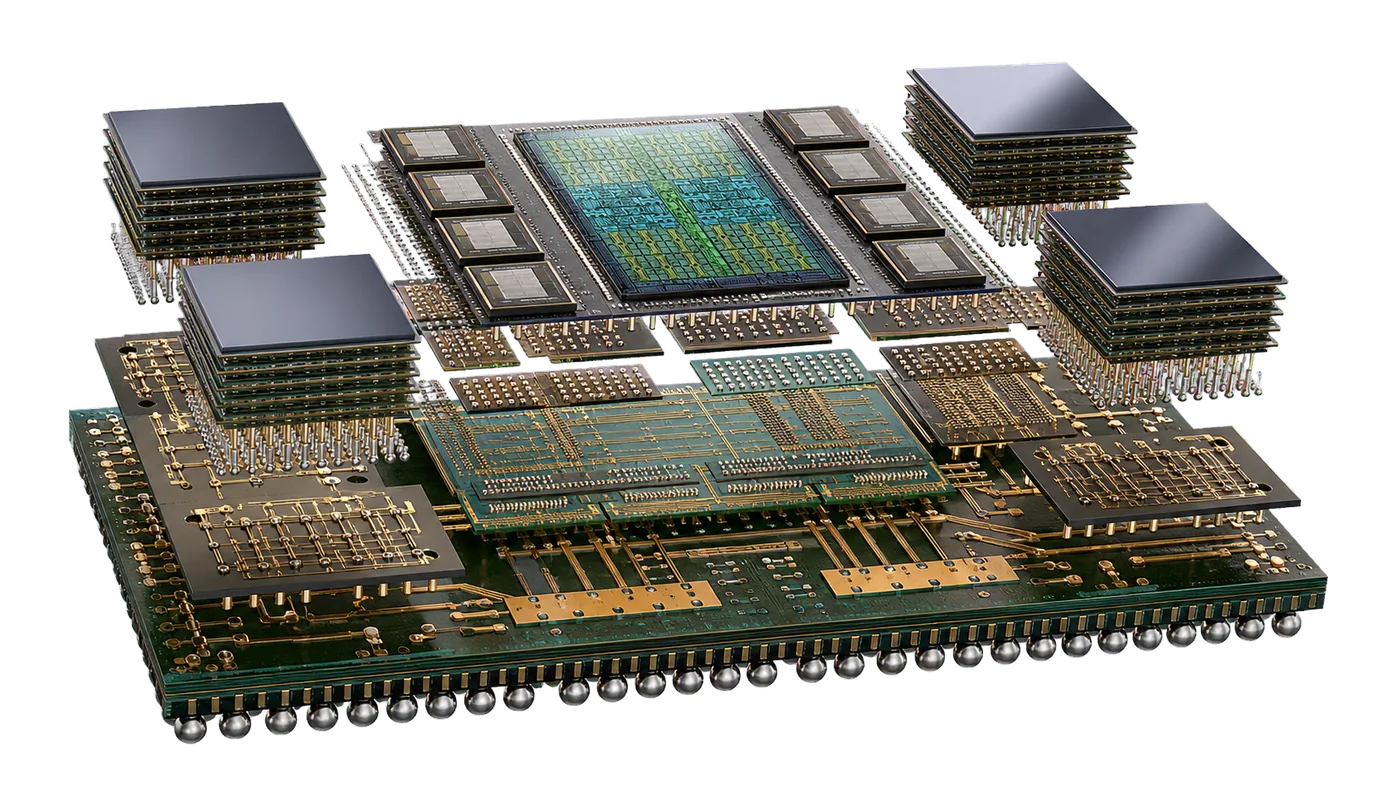
Descent: research into a spatio-temporal chiplet architecture — specialised logic, memory-adjacent computation, and software-directed scheduling — pursued so the economics of local intelligence improve with every generation.
The layers are deliberate. Systems establish the position. Software makes it useful. Research compounds it — over a horizon measured in generations, not quarters.
The principles
Five commitments run through everything Keyloh designs — from the systems shipping first to the silicon being researched.
Unified memory
One pool, shared by all compute — the ceiling that decides what a machine can hold.
Memory-local computation
Work happens beside the data, because moving tensors costs more than computing with them.
Efficient model execution
Models resident in memory, precision chosen per workload, whole teams served at once.
Modular scaling
Systems stand alone or join their full cluster — and behave as one machine either way.
Software–hardware co-design
The scheduler is designed with the silicon, not after it.
Local by default
Everything operates within your boundary — owned, not rented.
Where this matters most
The case for locally held intelligence is strongest wherever the work is serious and the data is not free to travel.
-
Where discovery happens
Laboratories, research groups, technical teams. The constraint is continuity: the freedom to experiment without a meter running, and to keep the resulting knowledge where it was made.
-
Where obligations bind
Regulated industries, professional practices, institutions entrusted with the records of others. The constraint is custody: capability that operates entirely within a boundary the organisation can point to and defend.
-
Across the wider ecosystem
Integrators, builders, and service providers whose own work grows more valuable as compute moves closer to its point of use. The constraint is a path: a practical way to bring advanced capability where the centralised model was never designed to reach.
Wherever the data cannot travel, the intelligence must.
Concept imagery — the Descent programme
Place it. Power it. Own it.
The Telos range arrives pre-configured on Keyloh AI OS — models installed, serving from first boot. Reservations are open; no payment is taken.